Uncategorized

In Search Of

I’m feeling super-lazy today.  This weekend was fun, but a lot of work.  I made 2 kinds of jam and some mushroom ketchup, as well as dissected the structure of Madeline L’Engle’s “A Ring of Endless Light.”  Not the exciting stuff that blog posts are made of.  It has dawned on me, though, that I haven’t posted any writing in a while.  And so here you go: this is 1/2 of a story  I’ve been finessing the ending of before I start shopping it again.

A.A. Milne

In Search Of:

“Do you think she wanted to drop it, or do you think it was an accident?” said Jack to Fritz.

“Does it matter?” said Fritz. “We still have to find the bloody thing. And if you thought the proverbial needle in the haystack was bad, try the golden apple in the miles of mud. We’ll never get back to Olympus, you know.”

The green khaki they both wore was stained with dry earth, their leather boots caked, their round helmets just covering their eyes. The helmet was just for looks. Even if someone dropped a grenade or a bomb into the pitted, broken earth of no man’s land, it wasn’t likely to harm either of them. Or not for long, anyway.

“Speak for yourself,” said Jack. “This war can’t last forever. We’ll find it. I have confidence.”

“I had confidence last year,” said Fritz. “But I don’t anymore. You’ve heard of the hundred years’ war, right? Doesn’t have to stop any time soon, brother.”

The land he and Fritz were walking over was nothing but violent pits of loose earth that undulated like waves, barbed wire fencing stuck between.

It had been almost three years since they frog marched him and Fritz down the mountain top and told them not to come back without apple in hand.

The golden apple. It had been so long, but Jack still remembered the way the thing reached into his mind and implanted its own memories, all of them horrifying. The desire that came with it, the wonder, the need to own it, to look into its precious golden surface forever. The urge to cut the eyes from anyone else who wanted to look too.

The size of a fist. Perfectly round, glossy, tantalizing, with a thin silver leaf reaching from the spindly, ideal stem.

“Come on, put your German on,” said Fritz, nudging him. “This is the spot – whole bunch of shelling, no movement either way. Looks promising.”

Jack shrugged and then touched his hand to his helmet and his sleeves, and then to Fritz’s. A faint, sweet smell of ozone rose from his palms and the flags on their uniforms turned to black, white, and red stripes. The holes covered over with green. Their boots gleamed.

“Which story are we trying?” said Jack.

“I dunno,” said Fritz. “Inspecting the troops in the wake of the General’s visit?”

“Sure,” Jack nodded.

Fritz made the vehicle out of the clouds that coalesced in the gray sky. He beckoned them down and encouraged them into the shape of an armored car, German flag on the door and flying from the side mirrors. They both got behind it and walked it up to the trench camp, and they both made sure to step out of it via the illusory door Fritz waved into being. It looked good unless someone tried to touch it, but Fritz parked it far enough back that probably no one would.

They had learned after Fritz took a bayonet to the thigh in the Italian camp almost 2 years ago. Blood everywhere and a whole week lost while his hamstrings knit back together.

The scene before them looked like all the other trenches they had been to. Broken earth, barbed wire, a deeper wound on the pitted earth that was the fissure these men fought from. The round helmets of a few men in the distance peaked over the wound, scanning the bare earth beyond for the siege of men that would come crawling over the top; if they weren’t the men crawling over the top of someone else’s trench instead. Every few hundred feet stood a machine gun tower.

The sentry nearest them raised a hand.

“Guten Tag!” Fritz called.

“Guten Tag,” said the sentry, saluting. “What brings you both today, Majors?”

“You will point us to your Kapitän.” said Fritz, in fluent German.

“Right away, Major,” he said. “Lars will take you.”

They followed behind the Musketier, keeping their shoulders upright, their strides purposeful, their movements sharp. The man led them down a wooden ladder, and then through the muddy trench made of piles of sand bags. Jack could touch the walls on either side if he reached out his hands far enough. Dark stains dotted the top row of bags.

Inset into the back of the wall was a framed doorway, which led into a hole with a desk in it. The walls here were wooden.

“Men from the Home Office to see you, Kapitan,” said the Musketier, saluting.

Jack blinked, closing his lids hard. When he opened them, they had adjusted to the darkness as if it was day. The room had a bare bulb swinging from the ceiling, and had been wallpapered in something floral that might have once been cheery but was now dust like everything else.

The Kapitan rose and saluted to them. Jack and Fritz soluted back.

“Nothing confidential,” said Fritz. He handed the Kapitan a folder. Inside it was the page he had encouraged weeks ago to appear like an official telegram.

He let the man look it over for a moment before he spoke again. “We are to bring you this news, and also to inspect the troops ourselves, as a precursor to the Generalleutnant’s arrival. He will be here in two days. Plenty of time for you to prepare your men.”

“Certainly,” said the Kapitan. “Should I call them now?”

“No rush,” said Jack. “We will spend most of the evening with you. We know there isn’t much room and won’t claim a bed, but part of our orders also include bringing back any requests for equipment you might need, or additions to these accommodations.”

“We are hoping not to be here long,” said the Kapitan. “Within the next month, we will take the next trench ahead from the Americans.”

“Certainly,” said Fritz. “But you will, of course, still hold this trench. We are not speaking of great things. Perhaps reinforcements to walls and frames?”

“Of course. We always need additional sandbags, but could also use whatever wood can be spared.”

“So we have your permission to go where we will and see if there is anything else we think you could benefit from?”

“The Generalleutnant orders it,” the Kapitan shrugged. “I will muster the troops for inspection just before evening mess, and then you must dine with me.”

“We would be honored,” said Fritz.

“With your permission?” said Jack

The Kapitan nodded and stood again. “You are dismissed.”

They traded salutes.

#

Out in the trenches again in the dark earth beneath the drab sky, they were alone except for the men on the top of the wall who looked only to the horizon. Jack took a deep breath and inhaled. Nothing but the faint traces of molasses ozone that came from their uniforms, and the piece of paper that was still inside the office.

He shook his head. “I can’t smell it,” he muttered.

“Of course not, idiot,” said Fritz. “None of them are pretending right now. They’re alone. There isn’t any fake to smell yet. You try this every time.”

“One of these days, we won’t have to stay until dinner to figure it out,” said Jack.

“Smell anything else, though?”

Fritz was talking about the smell of the golden apple, cloying and metallic.

It had been too long since either of them had seen the golden apple sitting under a crystal dome on Olympus. It was so long ago that Jack couldn’t remember the smell. He just knew he would remember it when he caught a whiff, that it was unlike anything else he had ever smelled. It was gunpowder and desire; honey and hunger; sex and blood.

“No,” said Jack. “None of that, either. It isn’t here, but we still have to ask.”

“Bloody unlikely that’ll be any help,” said Fritz. “Thousands seen it, no one’s grasped it. Come on, let’s get this ‘inspection’ going. The sooner we can move on…”

“Yeah, I know,” said Jack.

#

The Kapitan mustered the men just before dusk duty. They stood at attention, backs to the walls of the earthen trench, chests proud and muscles taut. Jack walked behind Fritz and breathed in. They got to the middle of the row before Jack smelled it; the ozone smell gone wrong, sweet rain with undertones of phlegm, the lie.

This one had the sickness.

He was pretending pretty well. The smell was not overwhelming, so maybe he only had obsessive thoughts of home now. But soon the Apple would take him, and he’d be at the mercy of what it chose to show him: cannon fire raining from a ship, pelting the walls of a seaside fort, men falling from the ramparts into the water; A woman plunging a knife into a man’s back, he gasps a sucking sound before falling to the dirt.

It would eat him. It ate anyone who was mortal.

Jack made note of the soldier. Blonde hair too long, escaping from his helmet. Grimy moustache above his lip. He may have been fat once, but now his cheeks hung from his face. His attention pose was looser than the men around him.

“Very good, Kapitan,” said Jack. “You have an impressive force here.”

“Thank you.”

#

Jack snuck out during dinner. He excused himself from the table and then made his way to the barracks. His calculation was right. The rest of the men were at mess, but this one had stayed behind. He was staring at the wall, hand poised over a piece of paper as if he was writing a letter. But the paper was filled with apples, the lines of them frayed and round.

“What is your name?” Jack asked him.

He startled. “Rolf,” he said, covering the paper with his arm.

“And you have seen the Golden Apple?”

“Is that what this is?” he said. He picked up the paper and held it out to Jack, hands quivering.

“I don’t know,” said Jack. “Tell me.”

“I was on patrol with – a friend. Oskar. Oskar Berger. And the Americans started shelling. A wave of dirt flew up and something landed next to my shoe. I thought it was a shell. But it didn’t blow. It was gold, and it brushed against me. But another shell hit, and this time it was a real one. It hit Oskar, and it… the earth and his body, his… it all thrust me aside and knocked me out.”

“Where?” said Jack. He could taste the apple now, the metal and cake. But it was the ghost of a smell, the memory of it.

“Oskar. Oskar Berger. Another faceless man lost to this…”

“Oskar Berger. We both remember him now,” said Jack.

“When I joined this war, I was so…” said Rolf. “All we saw was uniforms and glory, the heady shock that reverberates through your arm when you shoot a rifle, the glee that rises in your throat. We didn’t know what happens when the bullets hit their target, what your throat feels like then.”

A sob caught there, Rolf’s Adams-apple bobbing, keeping it in with a sucking sound.

Rolf swallowed. “I don’t know,” he said. “It was months ago. We weren’t even in this trench back then. I don’t know where I saw it.”

Jack sighed. “No, no. Of course you weren’t.”

“If you find it…?”

Jack shook his head. His answer was always the same. “You’ve touched it, and your mortal brain couldn’t handle the strife it’s been through,” he said. “Once you’ve been touched, it never lets go. That’s it. You will have to learn to manage as best you can.”

“No,” said Rolf. He closed his eyes, and the silence surrounded them. He opened them again. “And when will this damned war be over?”

“When I have found the apple,” said Jack. “Have faith, brother. I’m trying as hard as I can.”

Would it be another hundred years? Two?

Rolf covered his face with his hands and turned away. Jack went back to the bleak Kapitan’s quarters to finish his meal.


Categories: Uncategorized, Writing | Tags: , , , , , , , , , | Leave a comment

Weekly Woes

IMG_20160818_150230

It’s been sort of a terrible week.  I spent 3 hours waiting in a scary train station parking lot last night for Brian to navigate the broken down and delayed system back.  I have received a quick rejection letter and am feeling downtrodden about it – my 16th this year.  There is an army of ants who are attempting to take over my desk at work.  Brian has been ill and I’ve been doing my best to take care of him when I’m actually home (which isn’t much).  The weather is over 100 degrees and melty.

It’s one of those times where I wonder if running away like I tried when I was five is still possible.  But most days I really like my life.  The law of large numbers just insures that sometimes all the crap is stacked up in a single week like this.

I have been reading Storyteller by Kate Wilhelm, one of the founding teachers at the Clarion Writer’s Workshop.  It’s a lovely book, part writing advice and part memoir, and it’s taught me some stuff already.  You know, besides igniting all the regular yearnings to one day attend Clarion into a fervor.  I’m going to rewrite the ending to the story that was rejected and see what happens next.  I’m also itching to get my hands on some inexpensive used paperbacks so I can start dissecting the authors I love and see if I learn anything.  Which I thought I would never voluntarily do.

Friday is my day, though.  The Redlands bowl is having its last performance of the season, which means William Tell and fireworks.  Totally my thing.  Couple that with some kitten cuddles and I’m sure I’ll be feeling much better by the time next week rolls around.

Categories: Life, Uncategorized, Writing | Tags: , , , , , , | 5 Comments

Colonial Cooking

IMG_20160804_123750

I found the Colonial Williamsburg Foodways blog, I think via Pinterest (although I can’t remember now where I found the link through a link).  It’s spurred my thirst for everything historical food.  Which, to be honest, wasn’t that far off to begin with.  I like cooking.  I’m a history major.  It seems like the perfect marriage of hobbies.  I’ve been looking at all sorts of historical food sites, and everything is SO different from our modern recipes.  I mean, I’ve known that food goes through phases of popularity, but I have never seen anyone use heavy spice without adding sugar (for instance), or dealt with that much game. There are savory puddings, oysters in everything, and a penchant for white vegetables, for some reason.

I bought a little pamphlet version of a revolutionary recipes cookbook at the Yorktown Victory Center for the Wassail recipe a few years ago.  Yesterday I tried some of the other recipes in the book.  After that, I’m definitely going to go for some of those Williamsburg recipes.

Martha Washington knew what was up, guys.

I made her Chicken Fricassee, and it’s maybe the best thing I’ve ever cooked ever.  And that’s saying something, since my rack of lamb with sour cherry sauce is something Brian’s still talking about 6 months later.  The chicken here is heavily spiced with nutmeg and cloves in a gravy that’s light, salty, and sweet all at the same time.  Brian took one spoonful of the gravy and told me I was making that for Christmas next year, whether I liked it or not.  I’m seriously dreaming of sailing in to it tonight.

I also made a Sally Lunn bread, which is really half cake, half bread because it has eggs and milk and sugar in it as well as yeast.  It turned out to be this buttery, crusty thing with a soft cakey center, almost not sweet at all.  It was a lot of work – I had to hand-beat it for over 10 minutes – but worth it for special occasions, certainly.  I took a small sliver to taste how it would come out, and then took another small sliver, and then another…

I learned also that the more people who came, the more types of dishes you were supposed to have – up to 18 different items for 15 people dining at your house.  Yikes!  Chicken Fricassee and Sally Lunn are 100% hits, but there are a million others that I’m dying to try.  In the recipe-testing column, are these:

For desert, Syllabub (from the cook book).  But definitely Martha Washington’s spice cake and marzipan hedgehogs.  Those hedgehogs are my FAVORITE thing so far. So cute that I don’t even care if they taste bad.

So, no kitchen disasters yet. And if the best happens, I’ll have a whole slew of fun recipes under my belt for special occasions.  My stomach is looking forward to it, as are my fancy history vibes (don’t ask me what those actually are, I couldn’t tell you).

Categories: Life, Uncategorized | Tags: , , , , , , , , , | 2 Comments

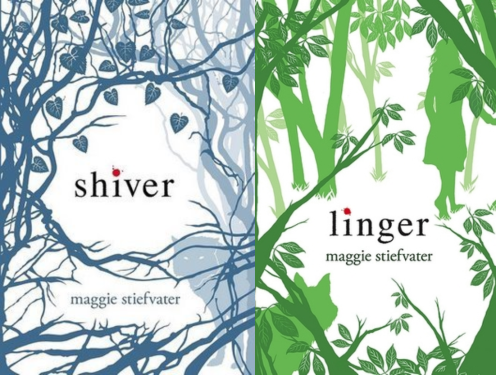
Book Review: Wolves of Mercy Falls (Shiver, Linger)

ShiverLinger

I fell so hard in love with The Raven Cycle books that I started following Maggie Stiefvater on Instagram and Tumblr.  Just so you know, her life is way cooler than yours (and mine).  I offer as evidence her explanation of a race between her and John Green, and their subsequent car fires.  I want to have car fires.  Or, rather, I’d like to have car fire stories I can tell after I’m home and safe.  Bonus points if I don’t actually have to have the car fire to begin with.

Yes, I know.  This is why I’m never going to be that cool.

But her awesomeness and my religion-like devotion to Blue and the boys meant that I needed to see if I had an awesome backlist to read.

The verdict?  While I’ll read the stuff she writes going forward (and maybe the Scorpio book?), I’m not terribly impressed with her older work.  I read the first two books of the Wolves of Mercy Falls series (Shiver and Linger), and I’m not sure if I’m going to read the last one.

The series has all the things it should to be amazing: beautiful writing, interesting characters.  It’s all danger, ice, snow, and wolves with some books and music and high school antics thrown in for good measure.  It’s like if all your fantasies of what Twilight should have been come true.

Except that for some reason the yummy ingredients make a flat cake.

You can see glimmers of the sassiness and truth that made Raven Boys such a gem, but the books never quite get there.  The best character in the whole series is Rachel, who gets very little screen time.  Grace, the main character, is too bland to inspire devotion and not bland enough that you can insert yourself on her without thinking about it too much.  The books are beautiful, but they lack profluence* in places as Stiefvater lingers on the relationship between Grace and Sam or on description. Plot twists are predictable.

I can forgive all those things, though. I have before for other authors.  I think the reason I can’t here is that there’s nothing new to grasp at, to make the other sins worth it.   It mostly feels like a series I’ve read before.  I like that series, I like that this is an ideal version of it, but in the end it has nothing to offer that I don’t already know.

That being said, I was interested enough to read the novels through pretty quickly.  The emotion she evokes in the books is genuine, and I found myself caring, if not about the characters, then about the outcome to their stories.  I will also say that the books won several awards, so I might be full of crap.

And, of course, as I’m looking at the book art to download the covers on the top of this blog I’m also seeing all the fan art and getting warm fuzzies about the series and the characters.

It’s a solid choice as a read, there are just other things out there with more to them.  I would recommend the Wolves of Mercy Falls books to people who haven’t read Twilight, and would heartily recommend the series instead of Twilight.  But if you’ve been down that road already, just go pick up Holly Black’s The Darkest Part of the Forest instead.  You’ll get more bang for your buck.  And if you haven’t read The Raven Cycle yet go do that IMMEDIATELY.


*Profluence: A term coined by John Gardener in his book “The Art of Fiction.” The sense that a plot is flowing, moving the reader continually and evenly toward a goal that is well planned; that we are getting somewhere.  It’s the way the cause-and-effect connective tissue that makes up a novel interacts with the overall plot and story arc.

Categories: Book Reviews, Uncategorized | Tags: , , , , , , , , | 1 Comment

Olympic TV Watching

IMG_20140427_083850

On our way in to work (yes, we’re sharing a car again… the Cavalier once again bites the dust), I asked Brian what I should write about for the blog entry today.

He told me that I should write about what an awesome husband I have, who picked up and vacuumed the entire downstairs, deep-cleaned the kitchen, and made all the meals for the week.  Which is a true story.  I have a pretty awesome husband.

And then he told me that I should probably just write about the Olympics instead.  So here I (sorta) go:

The Olympics are one of my favorite things.  Mostly because there’s weird sports that you never get to see on TV otherwise, like archery, table tennis, and synchronized diving.  Brian likes it too, although not as much as I do.  We also have a love/hate relationship with TV which makes my love of the Olympics tough to indulge.

13 years ago, Brian and I decided that we wouldn’t get a TV when we moved in with each other.  He felt like the constant din of TV was distracting and the ads annoying, and I felt like my mother had limited TV so much for us growing up that living without it wouldn’t be hard.  That was in the dark ages before Netflix and online streaming, and it turned out to be awful until we expanded our movie collection enough that there was entertainment in the house.  But we did it.  And Netflix then felt like the decadent version of having that vast movie collection.  There are only 3 shows I HAVE to watch, and they are all available via online streaming: Project Runway, This Old House, and The Great British Bake Off.  We have an antenna that used to work well in Claremont but is optimistically sketchy in the new place and really only gets channel 4.  But that’s enough for State Of The Union addresses and Rose Parades.  We make it work.

Why is this better than just shelling out for cable you ask?  Well, it’s cheaper.  But mostly it forces us to be deliberate about what we’re watching.  There isn’t any more horrible family drama on Judge Judy after Heraldo because that’s what’s on the channel and no one changed it.  We consume, yes.  But we consume deliberately.  And wasn’t that what the message of Walden was all about?  Living deliberately?  I’m sure that’s what Thoreau meant…

But I digress.

My point is this: the way NBC has the Olympics locked down is insanity.  There is almost no way to watch the coverage from my place without shelling out for cable.  You can’t even stream it online without a cable account!! Brian and I went on an epic journey on Friday night to buy a Roku, then went back to the store for the HDMI cable we forgot, then set up the thing and realized that even the places that said you could get all public channels in the US for free weren’t offering NBC unless you paid.  So we caved.

It was a frustrating night, to say the least.  But it ended with the two of us on the living room floor in a blanket nest watching the opening ceremonies, so that was alright.  In fact, it was nice.

The thing that tickles me most about this weekend is that I have a wonderful domestic husband who did all the chores while I laid on the couch and watched sports.  We have become the traditional American family, in reverse.  It will all go back to normal in a few weeks, I’m sure.  But in the meantime, I intend to enjoy the irony.  And the Gymnastics.

Categories: Life, Uncategorized | Tags: , , , , , , , , | 2 Comments

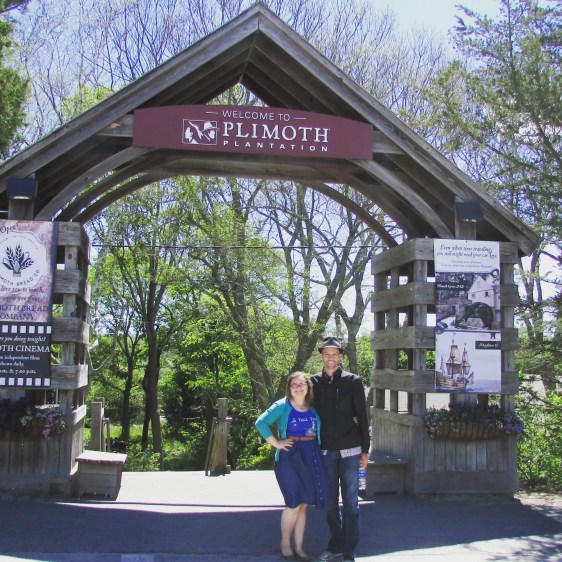
Of Plimoth Plantation

IMG_20160730_073256

I don’t know if you have ever been to Plymouth, Massachusetts, but it seems like much of the East Coast at first glance.  There is a gray quality to the light that makes the beaches blander, the seas bluer, the greens more vibrant.  Unless you are in a formal town and there are slim granite curbs, the roads are all rimmed by gravel and scrubby grass that collects spindly wildflowers and clover.  The trees beyond the green strip all mound together into a heap of foliage that follows next to you as you drive.  Tucked between the trees are clapboard houses with shutters.  They’re boxy and white, or maybe there’s a wide porch with a blue roof, or a tin star tacked to the siding.  All of them have shutters, new and old.  The beachfront in Plymouth is busy and modern.  There’s an ice cream store with a teal marquee and gold gilded letters.  Pilgrim Gifts hugs the triangle-shaped corner.  A granite pavilion houses a small, disappointing rock that says 1620, and out in the bay stands the medium sized Mayflower II.  The shore stretches, flat, brown and blue, to the horizon.

It’s beautiful.  And it makes me think of winter snows and a shallop speeding through the waters, everything unknown.  But it’s not any different than any other seaside town boasting a historic item or two, really.  Not unless you know the history of the place. Not until you step into the museum that is a recreation of the village as it was in 1627; Plimoth Plantation.

There are places you go to that steal your soul and you never belong to yourself again.  Places you’ve dreamed, somehow, or maybe it’s just that the air is in your blood in a certain way.  But all you need is one whiff and you’re home, the angst in your soul is quiet, all is right with the world.  Maybe they have nothing to do with you before this moment, but it doesn’t matter.

Plimoth Plantation is that place for me.  The gray houses, their roofs thatched, seem to grow out of the scrubby kitchen gardens that are rimmed by uneven gray fencing.  A dirt path stretches down to the ocean, which is ever more blue than you remember it.  At the top of a hill is a boxy fort housing cannons and also the church, the inside dim, broken up only by a few slim windows.  The village smells of wood smoke even on the hottest day.  Inside the houses, people in bright period garb will speak with you in a foreign accent about everything from religion, to thatching a roof, to their opinions of their neighbor.

There is always something that doesn’t quite dawn on you that comes out in these encounters.  Most people know that the pilgrims landed far north of where they were supposed to.  What struck me this time was the woman who lamented that most of the Mayflower crew had died, and if the ship couldn’t get back to England then their supply ships would never come to the right place.  At best they would be declared lost at sea.  At worst they would all starve in a wilderness that had already claimed half of them and looked to claim more when their wheat wouldn’t grow properly like it did at home.  This was before Squanto and Samoset.

Or the gentleman who had relied on the advice of a few summer fishermen who touted the mild and warm climate in New England, always home before the fall frosts set in.  He had not brought a winter coat over, and his neighbor charged him a fortune for an extra one.  Because no one knew what the winter was like.

Chickens roam in the streets and attempt to forage in the houses if someone doesn’t kick them out.  There are reddish bulls in the far pasture.  Unless the task is a dangerous or fiddly one, you will likely be asked to help hoe the garden or tie knots in the fishing rope.  The words in the bible all have an “s” that sometimes looks like an “f.”  Their earthenware cups have too many handles.

I hadn’t been for, oh, probably 15 years.  But I got to go again this summer.  It’s just as much mine as it ever was.  It’s a better experience than I remembered.  I wished again, for the millionth time, that I could move in and stay in that blue and gray world forever.  I ate authentic food, reveled in the green streets, asked questions on horn books, thatch, wood storage, and religion just to hear the answers.  Brian helped Patience Brewster hoe a row in her garden. I wished all over again that I could don those clothes and pretend to be a pilgrim for a year, even if I did have to go home at night.

But it was back on a plane for me, and I’m now residing in the golden dryness that is California again.  I hope I can get back there sooner than 15 years next time.

And in the meantime, I’ve pulled out some of my pilgrim books again.  First on the docket?  A collection of primary source writings called “The American Puritans, their Prose and Poetry.”

I’m also enjoying all the pictures I took:

Categories: History, Life, Uncategorized | Tags: , , , , , , , | Leave a comment

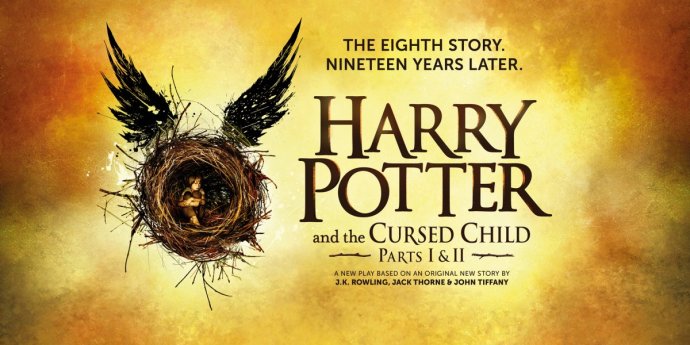
Book Review: Harry Potter and the Cursed Child

Okay, so I know that “keep the secrets” is a thing, and I’m going to try my best to hold to that.  However, this review discusses the plot of the book, so be warned.  I won’t give away anything that is a major secret, but reviewing a book without talking about the book is impossible.  If you want to stay 100% pure, don’t read any further.

HP15_Q4_Square_LS_Pottermore

The Harry Potter books are an interesting thing.  They’ve become such the stuff of legend that it’s hard to separate the myth from the actuality.  I just know that I read them recently and fell in love all over again, so they do stand the test of time.  I was obsessed so quickly with the series when I was younger, attending every midnight release and reading the book in a day.  I’m a huge fan.  I’m quiet about it, but that doesn’t mean the fervor burns any less bright.  I didn’t attend the midnight release for Cursed Child, but some things haven’t changed.  I read this book in a day.

In general, I don’t like plays as reading material.  I think I should say that, too, so you know where I’m coming from.  Without anyone to speak them, the words can sound sappy and trite.  Without the emotion and the inner life of the characters, the narrative feels cold.  That disappears when you have actors to play the parts, but reading the script on the couch doesn’t help.  I was predisposed to love the book; I was predisposed to hate the book.

I ended up falling somewhere in between.

The basic premise of the play is this: Harrry and his youngest son Albus don’t get along.  At all.  Some of the problems seem to stem from the fact that Albus was sorted into Slytherin and makes a best friend in Scorpius Malfoy, but mostly it’s because Albus can’t come to grips with some of the things Harry has had to do to save the world.  Most notably, the death of Cedric Diggory.  Shenanigans ensue.

By the end of the first part, I was angry.  The plot seemed much like Back To The Future: Harry Potter Edition.  I felt like the whole thing was an excuse to trot out everyone’s favorite characters from the series who died or disappeared and had nothing original to offer me.  Was it neat to be back at Hogwarts?  Yes.  But that’s all I can really say for it.  The world felt cold, the scenes passed too fast.  I loathe reality reunion shows when everyone talks dirt about the contestants and rehashes their time in the sun.  I didn’t need the Harry Potter version.  I could go on and on: Inexcusably, Ron is the buffoon he was made out to be in the movies, and not himself at all.  They play with time, and the way they play with it is so anti the rules set out in the book that it’s maddening.  People are outright friendly to Malfoy, who did unspeakable, unforgivable things in the novels. I mean, I’m all for nice.  Nice is what you do when you’re an adult.  But friendly is a little steep for someone who broke your face, tried let Death Eaters into the school, constantly uttered racist slurs, and allowed your best friend to be tortured.  How much time do you have for me to rant?

But by the end of part two, it had redeemed itself.  Not enough to be fully satisfying, but enough that I didn’t feel like my money had been extorted.  The kids end up falling into disaster, the adults band together like old times to try and help, and it’s suddenly a new story with the old relationships I know and love.  It suddenly feels like Harry Potter and it starts to really grapple with its premise that sometimes bad things have to happen to create a good world. It becomes more the book I wanted.

I’m not gonna say don’t read it.  Because you either will or you won’t.  And I will also admit that there may have been no way this book could live up to the huge expectations I had of it.  But if you read it, just know that it probably wasn’t the thing you were expecting to get, though some of the qualities make sticking to the end worthwhile.


Categories: Book Reviews, Uncategorized | Tags: , , , , , | 1 Comment

Book Review: Fragile Things and The Darkest Part of the Forest

Neil Gaiman - Fragile Thngs2233284_orig

I realized, as I was writing this review, that I have reviewed Black and Gaiman together before now.  Their work is so different,  but it feels like 2 sides of the same coin in many ways.  Gaiman writes mostly for adults, Black for YA.  Gaiman deals in myth, Black in fairy tale.  The books are filled with the weird and the strange.  And those weird, strange things often take place in the modern age.  It was an accident that I’m putting them together this time.  They’re the only 2 non-fiction books that I haven’t reviewed yet.  It seemed right to do them together at the same time. So here we are,  with the books fulfilling the “a book that will be a complete mindfuck” and “a book you bought long ago but still haven’t read” categories for the reading challenge.

Fragile Things by Neil Gaiman:

I should probably couch this review by saying that I mostly don’t enjoy short stories.  Or, rather, that there is a celebrated type of short story that I loathe, full of beautiful words and terrible happenings that brings me more unsettled upset than entertainment.  It’s a staple of the genre. But I love Gaiman, and I have read all his novels already.  Some multiple times.  Also, his work is always a mindfuck.  It’s strange in ways that are completely right yet unexpected.

I enjoyed Fragile Things and I didn’t, in about equal measure.  A Study in Emerald is worth the price of the whole thing, I enjoyed it so much.  I think anyone with a penchant for Doyle would.  But there were others in there that just made me rather horrified.  They were all so hit and miss that it’s impossible to go through and say worth it/skip of each, which I would have to do.  And to be honest, if you can find Emerald not in this book, that’s the route I would go with.  For me, the joy wasn’t worth the pain.  The quality of the work is amazing, the subject matter was not often my cup of tea.

Looking for something Gaiman to read?  American Gods, The Graveyard Book, The Ocean at the End of the Lane, and Stardust are all good options.  Looking for something new of Gaiman’s to read?  He just came out with a non-fiction book of essays “The View From the Cheap Seats,” which I hear is good (although I haven’t gotten around to it yet).

The Darkest Part of the Forest by Holly Black: 

Every time I read Holly Black, I remind myself that I need to read more Holly Black.  I don’t know why she doesn’t come to mind as an immediate “yes” author to me.  Everything I have read of hers has been joyfully frightening, fascinatingly horrifying.  This one is about a modern town on the edge of faerie.  There is a horned prince in the forest, sleeping in a glass coffin, and then he goes missing. And then people start dying.

It’s all the things I loved about the Tithe world with a more epic heroine to balance out the story.  There are several things in the genre that are always a YES for me (almost irrespective of content).  Fae, love stories, and women with swords are a few of those, which this book has in spades.  I loved it.  It made me want to buy Valliant immediately, and then re-read Coldest Girl in Cold Town.

I bought this book almost a year ago.  I don’t know what made me linger in reading it.  I lingered with Gaiman’s Ocean, though, too.  I think perhaps it’s because I know I’m going to love it so much and I only get to read it for the first time once, that I feel the need to savor it as much as possible.  Or maybe it’s a fear of ultimately not liking something I’m looking forward to so much.  Both Black and Gaiman always deliver, though.  I should remember that more.

The final verdict on Darkest Part of the Forest is go buy it now.

Happy reading!

Categories: Book Reviews, Uncategorized | Tags: , , , , , , , , , , , | Leave a comment

Jam, Bread, and RPGs

IMG_20160721_152957

I realized I’ve been binge-reading romance novels as comfort books because the news from the Republican Convention has been so depressing.  You know, among other things.

In times of trouble I have to turn to something.  Romance novels and kitchen exploits are my favorite thing to turn to.  The Roger’s Red grape vine has gone crazy on me, and I have a TON of grapes that are dark purple and that right kind of sour.  I’m planning on making grape jam this weekend before the birds can eat all of them, and possibly I’ll try my hand at a loaf or two of wheat bread.  I may even have enough grapes for a REAL, full batch of jam.

I made the tastiest Irish Blaas from scratch last weekend, and my bread-making confidence is all up in the lofty heights of amazingness right now.  It was easy, I just had to wait for rising.  Wheat bread now seems surmountable, even without a stand mixer with a dough attachment.  Kneading for 8-10 minutes?  Good exercise.  We’ll see if I continue to say that after my arms fall off this weekend.  Wheat bread is supposed to be the hard one.  It’s reputably dense if not done right, though I wouldn’t know.

It is 10 days from the end of the month, and I have already spent all of my allotted book budget.  Which means I will have to subsist on rereading like I used to do in the dark ages before there were e-readers.  Can I do it?  I can totally do it.  If nothing else, I have plenty of Kipling on the shelves.  The last time we moved, I was happy for almost a month on a book of his stories.

In other news, we’re starting a new Rippers game on Friday… which means new characters.  Which means new character backgrounds.  I didn’t have the gumption or the time to make it as much of a short story as the last character, but I felt like the one I came up with was fairly clever.  I’m working on all the short stories, but I don’t think anything is good enough to share currently.  So in its stead, you can read a few paragraphs about Meg Hews.

She’s got a signature weapon that I’ve named “Carrie” after Carrie Nation – the gal that used to go into saloons with an axe and break stuff (including people).  She was very anti-liquor and a little bit insane.  Badass women for the win.

78152e3749c19d8cd00e3ce771ee15bf

Photo by Caelkriss on Deviant Art – click picture to link.

Meg Hews:

There is an old assumption that men whose wives die in childbed visit their grief on their children, but Margaret Hews never found that to be the case.  Her father was a jolly man with a quick smile, a firm sense of duty, and a black-and-white view of the word.  He was never sad.  When her mother died he just raised her at the Pinkerton office, and when Uncle Charlie complained, Dad said it was Meg or him. Charlie knew Dad was too good an agent to lose.

Dad let her scramble around his desk and crumple up old newspapers, teaching her to shoot a BB gun at the tender age of 5, and leaving her with Uncle Charlie whenever he had to go out on a job.  Uncle Charlie voiced his dismay, but eventually he shrugged it off and taught Meg to play poker with licorice pipes for winnings.

Dad was against her taking the badge, of course.  But she wasn’t fit for anything else when she grew up. She wasn’t demure enough for the boys who wanted a gentlewoman and her housekeeping skills were atrocious.  She refused to learn to type.  The only thing she could do was shoot straight and spy a lie from a mile off.  Pinkerton Agent it was.

It would be easiest to make her way in an office where everyone didn’t call her Meggie or remember that one year where she executed all her dolls for murder and subsequently burned them at the stake in the metal office trash cans.  Embarrassing.

So when a spot opened up at the St. Louis office, Meg made Uncle Charlie pull strings to get her in.

Categories: Fiction, Life, Uncategorized | Tags: , , , , , , , , , , , , | Leave a comment

Short Stories Galore

IMG_20140213_145252

I haven’t done a post on how the writing is going for a long time, so I thought I’d do an update.

My attempt in June to write a bunch of stories based on cool photos I found mostly hasn’t panned out, because I’m flighty.  And because everything I’m writing these days has somehow ended up CRAZY, unsaleablely long.  I’ll maybe finish them someday, but right now I’d rather spend energy on other things.  Especially since it’s now the end of July and I’m no closer to making my New Year’s resolution than I was in January.  I mean, I guess I’m 2 dozen rejection letters closer, if we want to get technical…

In lieu of completing anything new, I ended up taking that time for administrative organization: I cataloged all the pieces of short stories that I have lying around, the full stories that were too problematic to print and needed re-writes, and organized the records of where I’ve sent everything I’m currently shopping.  Not fun, but a necessary part of this ‘trying to get published’ stuff.

I did drastic edits of 2 imperfect short stories, and am now doing rewrites on another 2 unfinished works that I’m hoping to get rotating.  Right now, I have 4 things on the market.  That’s at least twice as many as I’ve had at any given time before now.  I’m feeling pretty proud of myself.

I’m on draft 3 of my novel synopsis, too.  Which is just as hard to write as all they say it should be, if you were wondering.  Legitimately awful.  I’ve given myself a tentative finish date of August 1st.  It’s coming up quick!

So, no real news to report.  Just the ongoing tide of stories out and stories in that has become my regular course of things.  I’m feeling good about movement, though.  At least I’m being productive.

Now on to all that editing.

Categories: Uncategorized, Writing | Tags: , , , , , , , , | Leave a comment

Create a free website or blog at WordPress.com.