Posts Tagged With: Book Review

Fall-ish Reading List 2014

IMG_20150102_093232

In the holiday shuffle, I missed posting my fall reading list.  So this one contains everything I’ve read up until January 1.  It’s shorter because I’ve been doing less reading of other people’s novels and more reading of my own.  Draft 6 is in full swing.

So, without further ado, here it is:

1.      A Wonderlandiful World, by Shannon Hale – Fun like the others, but I missed Apple and Raven.  Hale does some brilliant stuff that is Against the Rules and Shouldn’t Work with the character of the narrator. And yet it does, perfectly.

2.      Demons, and other magic by Meghan Ciana Doidge – She did not deliver on a (stupid) thing she’s been threatening for three books now, so that made me unhappy.  Otherwise it was what it should have been.  Nice epic finish that felt big enough.

3.      Manon Lescaut by Abbe Provost – I can’t say I liked it, although it got me thinking quite a bit.  It’s one of those novels where I disdain the characters and think they’re all idiots.  But it broadened my horizons.  So I’m not sorry I read it.

4.      The Princess Bride by S. Morgenstern – If it was possible that anything could be funnier than the movie, this book is funnier than the movie.  The Florin jokes, abridgements, and history are the best thing ever, like I’m part of a massive inside joke.

5.      Attachments by Rainbow Rowell – Man hired to read company e-mails secretly falls in love with girl who keeps violating the e-mail policy.  The two gals are beyond hilarious, the main character is such a great guy, and I love this book so much.

6.      The Lake by Analisa Grant – I just… 1st person present tense was difficult for me, and the story was cliché.  But it had profluence and an interesting main character.  I gave up 1/3 of the way through.  Maybe I’ll pick it up again, I don’t know.

7.      A Garden Folly by Candice Hern – The stupid sort of G rated Regency romance I love a lot.  Although it does make me uncomfortable when a girl says no and a guy doesn’t listen, no matter how much she’s really enjoying it.

8.      Paper Towns by John Green – Looking For Alaska was a better “finding someone” novel, and An Abundance of Katherines was a better “road trip” novel.  But it enjoyed it, and would have enjoyed it more had I not read the others first, I think.

9.      The Grand Sophy by Georgette Heyer – Now this is what I look for in a sappy regency romance.  Sophy is delightfully uncouth, quippy, and still the toast of the town.  It’s such a fun novel!  I’m pretty sure Heyer is my new obsession.

10.  The Masqueraders by Georgette Heyer – A confusing start but ultimately fun.  Minus (miniscule) points because the siblings don’t have a great reason for masquerading.  Most of the novel had me in conniptions worried for Prue in White’s club.

11.  A Convenient Marriage by Georgette Heyer – I feel  like I shouldn’t have liked this one because of the abduction but I did anyway.  I could have done without the swath at the end where silly brothers are silly.  Otherwise impeccable.

12.  The Corinthian by Georgette Heyer – Considered her best by folks on Goodreads. It was cute, but I wasn’t super impressed.  The way she treats gender relationships sometimes bothers me, but not enough to hate the book.  It was a different time.

13.  More Than Somewhat by Damon Runyon – Why is he so wonderful?  I forgot how hilarious he makes the Broadway underworld of the 1930s and 40s.  I wish more of his stuff was available.

14.  The Coldest Girl in Coldtown by Holly Black – Oh CRAZY good, and perfect for the Halloween mood I was in.  Vampire novel meets quippy YA novel in the best way.  It was violent, but I found I could take it.  Seriously, this one is amazing.

15.  The Quiet Gentleman by Georgette Heyer – This one was sort of murder mystery-ish, although I knew who did it way too far in advance.  Once again, some unwanted advances are blamed on the flirtatious girl (sigh).  But I enjoyed it anyway.

16.  Dangerous by Shannon Hale – I love this novel, and the problems I saw in it the first time didn’t bother me at all the second time through.  The best part is still the funny names Maisy gives her false arm, and the bad puns.  They never get old.

17.  A Midwife’s Tale by Laurel Thatcher Ulrich – You don’t often get nonfiction books that focus on the daily lives of women.  And women in the late 1700’s? Sold! It was a fascinating read and taught me A LOT about colonial domestic life. Love.

18.  The Art of Asking by Amanda Palmer – It’s weird.  This book feels utterly familiar and yet new at the same time.  I am in love with her, and this book is all the toppings on the sundae of how she’s changed my perspective and my life. So good.

19.  Gone Girl by Gillian Flynn – Beautifully written. It made me angsty and paranoid, though. The things she has to say about relationships are so heartbreakingly true that it feels like I could get there.  And the end?  No.  Just, no.  Ultimately did not like.

20.  Great Expectations by Charles Dickens – I have never read any Dickens as an adult, and I’m enjoying it a lot more than I did when I was younger.  His character descriptions are delightful, and the story is so much more full.  Poor Pip and his fortune.

21.  Balls and Synthetic Cheese by Amethyst Hethcoat – A classmate of mine.  Such a weird and sometimes funny collection of short stories.  I had forgotten her penchant for unlikely metaphors and similes that make me grin. I was glad for the reminder.

22.  Rose Daughter by Robin McKinley – SO good, with that mundane quality in which nothing and everything happens which McKinley does so well. It’s a different book than Beauty, the ending far more satisfying.  Happily ever after is happy too.

23.  Landline by Rainbow Rowell – CRAZY good.  It made me think of Brian and the way things used to be 15 years ago when we were first dating.  It was sweet, and at this point I’m ready to read everything Rowell has ever written ever.

24.  Sunshine by Robin McKinley – It killed me that I didn’t have 12 hours to just sit down and read this thing all the way through.  Dirtier than most McKinely novels, but I didn’t mind.  This book makes vampire tropes look Hot (capital H).

25.  Fangirl by Rainbow Rowell – I love the way Rowell makes me think of my own college days.  It makes me want to love Brian in detail like that again.  Cath is so wonderful in such a messy way.  There isn’t anything I don’t love about this book.

26.  Charmed Life by Diana Wynne Jones – A re-read.  I forgot how terrible Gwendolyn is, and how funny Chrestomanci’s dressing gowns are.  And Millie! And the adorable but bitey dragon! Some of the best of Diana Wynne Jones.

27.  The Lives of Christopher Chant by Diana Wynne Jones – A re-read.  Because after Cat, you HAVE to have Christopher and his Almost Anywheres.  I might love this book more than the first one, although I nearly always read them in this order.
Categories: Book Reviews | Tags: , , , , , , , , , , , , , | Leave a comment

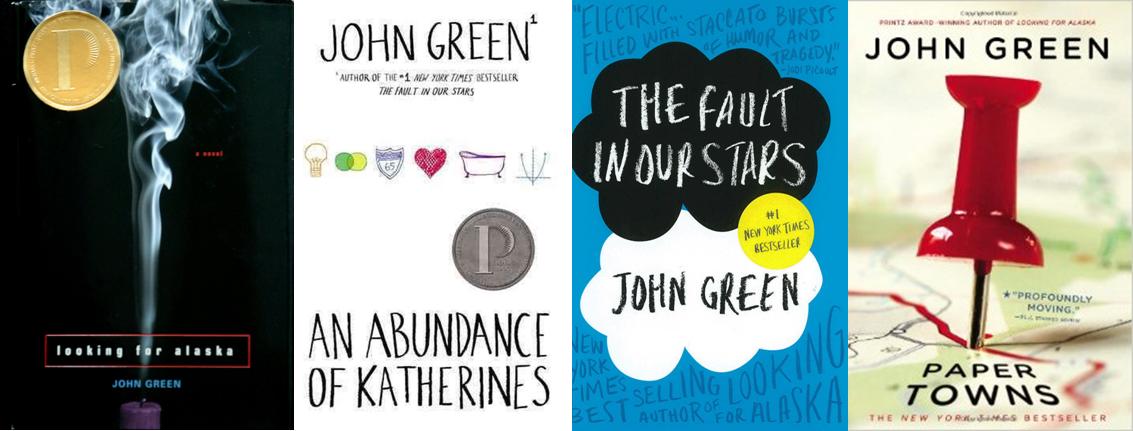
Book Reviews: 4 by John Green

John Green

Looking for Alaska:

I picked this one up because I felt I had to jump on the John Green, The Fault In Our Stars bandwagon. The movie was coming out, and his work was EVERYWHERE. Even if I didn’t like his stuff, it was enough of a cultural phenomenon that I had to have an opinion. I knew I couldn’t handle a kids with cancer, dying sort of novel so I looked at what else he had written. Looking for Alaska was a NY Times Best Seller.

I really loved the way he organized this novel. Most of his books are the linear chapter 1, 2, 3… you expect but this one isn’t. This one is broken up into “before” and “after,” but you have no idea what the event in the middle is until it happens. I had a growing realization of the doom of it as I read the novel and I hoped I was wrong. I wasn’t.

Pudge and the Colonel are hilarious with their dilapidated couch, and their milk & vodka antics. Alaska is a spitfire of a girl who feels so real that she’s easy to fall in love with despite the crazy that’s lurking inside. Pudge has his last words and his Great Perhaps. She has her Labyrinth. The pranks they pull are genius. Especially the last one, the one Alaska masterminded. The novel walks this line between tragedy and comedy, with plenty of embarrassment thrown in. It feels like a cooler, more expansive version of my own high school life. My only criticism is that Green uses the high school, class-mimics-life trope that is so overused in high school stories. But if it has to be used, this is the way to do it.

I read a lot, and what I am reading for is to find those novels that take up head space and linger. They are rare. If I don’t find it in 80% of the books I read, I am at least guaranteed some entertainment along the way. Looking for Alaska is one of the lingering kind. I read it on kindle, but I purchased the nice hard back. It’s a keeper.

 An Abundance of Katherines:

This novel wounded me, and I’m not really sure why. It’s lighthearted. It features the Archduke Franz Ferdinand, a pig hunt, a grand theorem of dumping, a cave lair, and plenty of other silliness. I don’t know how John Greene gets women so right, but his girls are all some of the few women written by men who feel real. Lindsay Lee Wells is the sort of girl I wish I was: bold with no nonsense and sweet all at the same time. Colin’s assertion that his prodigy status doesn’t automatically make him a genius (or even successful) felt so true. Hassan’s Arabic insults make me smile.

I was wounded, I think, because the novel is about the things we give up because our families have expectations of us. It seems easier to not do, or conform, than to decide and leave. It’s about the burdens of a good upbringing amongst a supportive family and how that can shape someone, too. Lindsay Lee Wells’ life is not like my life, but I recognized her problems as old frenemies.   It’s about other things too, of course, and some are probably more evident to others than my own take away. Like the quest of us all to be original and the ways history changes through the generations. But that was the one that stuck in my heart and kept me pondering.

This was another book that was a thinker. I’m a convert to the John Greene church of nerdfighting (or whatever). I bought this one twice, too.

The Fault in Our Stars:

Perhaps, you think, I should have seen it coming? I did not. I thought, ‘John Greene, amazing writer, in a lauded book I’ve seen on the internet everywhere. I never cry at books. After the other two, I think I’m ready.” I also made the mistake of reading it on my lunch hour. I have not cried over a book since I was 12 and John Brooke died in Little Men. I ugly cried on my lunch hour over TFIOS. I’m 32. It didn’t help that tall, quippy, Augustus Waters reminded me a little of Brian.

Maybe I wouldn’t like to be Hazel Grace with pips in her lungs and an oxygen tank, but I would like to have that smart brain of hers. She is another force of nature like the rest of John Green’s girls. Her parents are great people. Augustus’s search to make a mark on the world that was permanent is something everyone I know has experienced. Isaac’s blindness is sad. All of their stories are sad, but they are so smart and so funny in the midst of all this tragedy. It is gallows humor, but it is the funniest gallows humor I have ever read.

I could say things about Amsterdam. Or about universes needing observation, tasting the stars, video games and inspirational needlepoint, or the literal heart of God. But I realize that I can’t even put this book into words. It’s something that must be experienced. It defies summary.

This one wasn’t a thinker. It was a life changer. Those are the rarest kind of books of all.

Paper Towns:

When I originally read Paper Towns, I felt like it was the worst of all John Green’s books (That sounds more terrible than I mean it to sound. It’s still far, FAR superior to most things I come across. ‘Worst’ is in relation to the rest of John Green, not to the rest of literature). I will still assert that Looking for Alaska was a better finding someone novel and An Abundance of Katherines was a better road trip novel. I did like his thesis that some people are windows and some people are mirrors, and you never know if you’re looking in a mirror or a window when you see someone. I feel more mirror than window most days.

The book is beautiful, too; all these abandoned settlements, tract houses, and malls. Visiting them was fun. Learning about paper towns was so interesting. There is a dog named Myrna Mountweasel. I realized after a few days that I do find myself thinking about this one. After I had written it off as not his best, I found myself pondering the abandoned mall, and the place they find Margot, among other things. I’m sure if I had read this one first it would have been another favorite. I still recommend it, but after TFIOS it was anti-climactic. Perhaps that is the real reason I didn’t fall head over heels with it.

Categories: Book Review | Tags: , , , , , , | 2 Comments

Book Review: The Princess Bride

9780544173767

I hate to admit it, but I had never read The Princess Bride. I am a terrible nerd, and should be forced to hand over my membership card. No one who GMs Savage Worlds games should admit to such an atrocity, I’m sure. I have seen the movie. Many times. And I can quote large swaths of it. Isn’t that enough?

Yeah, don’t worry, I know it’s not.

I had several friends in middle school that loved the novel and thought Florin was an actual place. They would argue with me, and claim that they couldn’t wait to get their hands on the unabridged version if they could ever find one. That is the joke, though. There is no unabridged version, and there is no Florin, no Guilder. S. Morgenstern is a made up fellow, much like Daniel Handler is Lemony Snicket. I don’t wonder that our pre-teen selves were bamboozled. Especially in a time before internet was prolific. When things got heated, when they insisted that there were swathes on culture that had been taken out of the book and that obviously made those countries legit, I would stop arguing and start nodding and smiling. Whatever you want, friends, as long as I don’t have to believe it too.

I don’t know why I never picked up the book myself in those years. Maybe it was because I was too obsessed with Tolkien. His fantasies felt like histories. I dove into Middle Earth and didn’t emerge for years.

But I picked it up a few weeks ago, and this is how:

I have been trying to get myself to write more consistently. As part of that, for every 30 days I write (not necessarily in a row), I buy myself a present of a fancy book or two. I have been letting John Greene traumatize me for the past month, and enjoying every minute of it. So I thought I was going into the bookstore for hard back copies of The Fault In Our Stars, Looking For Alaska, An Abundance of Katherines, or maybe even Paper Towns (which I haven’t read yet). They were there on the shelf, and they were so pretty. But there were too many of them. I couldn’t have all four, and how would I ever decide?

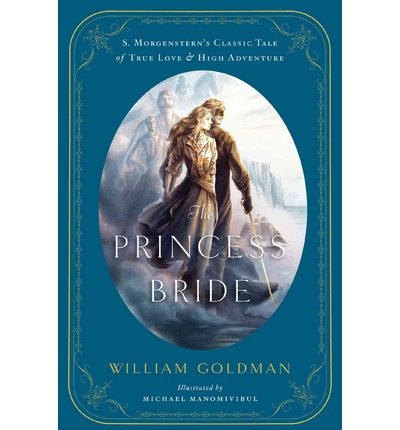
The Fantasy section is right behind the Young Adult section in my bookstore. I turned, and there it was in all its blue-bound glory tucked among the Tolkien books and the George RR Martin books. The illustrated Princess Bride, hard covered, beautiful, abridged. The pages are glossy, the illustrations are gorgeous. I had never read the book, but I knew I would like it. And that my husband would like it. And that it would be something to treasure for a long time, because they don’t make editions this pretty every day. It came home with me.

It reads like the movie, only much better. The snarky comments of Goldman, the abridger, are hilarious (he’s never read the novel – he’s only had it read to him. He cut out the parts his father used to skip). The story is broader and more real than the movie, which feels like a silly but intelligent fable. The characters are real and flawed, but worth loving and the back story Goldman has sketched out for them makes them all the more lovable: Buttercup’s love of dirt and slight stupidity; Inigo Montoya’s swordsmith friend; the Zoo of Death. The jokes are just as good as the movie, too.

I can’t say I’m sorry I read the book as an adult and not as a teen. I don’t think I would have understood the footnotes, the jokes about Goldman’s inability to publish Buttercup’s Baby due to estate problems with Morgenstern, or the way he talks about the country of Florin. It would have all gone over my head. What I would have been left with is the sweet, impossible fairy tale that appears in the movie. But I would have missed the sense that I was in on this gigantic inside joke. I am glad I bought it, glad I read it, and I think everyone else should too. No, really. Everyone. Especially if you are an adult and like fantasy novels.

Categories: Book Review | Tags: , , , , , , | Leave a comment

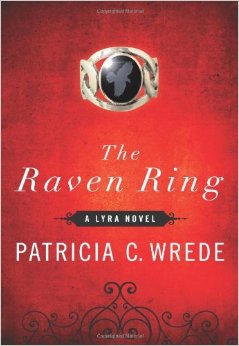
Book Review: 2 Lyra Novels, The Raven Ring and Shadow Magic

514YglUUiGL._SY344_BO1,204,203,200_51ydfPXOc8L._SY344_BO1,204,203,200_

Patricia C. Wrede, The Raven Ring:

Remember how I said I didn’t really like reading D&D campaigns? Evidently this book doesn’t apply. It’s full of tropes that usually infuriate me into a book throwing rage, and yet I enjoyed this. I can’t put my finger on why. The story line was one of the usual things in D&D campaigns. Mom dies, so scrappy daughter goes to collect Mom’s things only to find out that Mom was murdered and people are after her things. Chaos and kick-assedness ensue. For extra good measure, there’s an aristocratic, handsome (and full of himself) swordsman. He’s good at the fighting stuff, but not as good as the heroine. There’s also a cocky and friendly thief who belongs to a mafia-like family. There is wizard wisdom and magic galore. Everyone makes a pass at the main character. (sigh…)

But it was fun and light, with just enough surprises to keep the standard adventure plot feeling comfortable and not stifling. It did have a few flaws. The resolution felt like it blindsided me, it happened so soon and with so little warning. I thought it was another complication until I realized that the book was over. It was well chosen, though, and ultimately satisfying. I also can’t help but wish that the main character didn’t end up with any of the boys and just left for home without a fellow in tow.

Seriously, though, for as cavalier as I’m treating this review I did stay up all night to finish the book. That’s not something I do often these days. I also downloaded another Lyra novel ASAP and devoured that one in the space of about six hours as well. That book was:

 ***

Patricia C. Wrede, Shadow Magic:

The book is again along the D&D Campaign lines, and I fell in love with it harder than I did the Raven Ring. Kayl has two children and a dead husband when the magic seekers come to town. Escaping them, she’s pulled into her old life in the house of the Silver Sisters. They want her to go back to the twisted black tower where a dark ooze ate her best friends, leaving only four of them alive to bring the story to others. She’s fifteen years older, out of shape, and out of sword practice, but she has to go and complete the mission (children, and all of the people from the old expedition in tow) and hope they don’t all die in the process. She has memory issues, too, and one of her friends looks to die from the prophetic visions the tower gave him so long ago.

I felt like some of the reasons to have the children along were contrived, but they ultimately played an important part in the resolution of the story, so I forgave Wrede for the wishy-washy excuses to have them go the whole way. Besides the constant bickering between the siblings (which I’m sure is realistic but isn’t always fun to listen to), that’s really my only beef with the book. The rest of it was excellent. The plot is less predictable, and left me guessing (and drooling, and wondering) to the end. Pacing was perfect.

 ***

Some thoughts about both: Perhaps what I am fascinated by most in these books is the world of Lyra. It feels real, and I’m forever learning about secret societies, different races, and different customs that fascinate me. Her characters are so well developed that it doesn’t really matter if the campaigns are standard roleplay fare, because they trump cliché with humanness. With many bonus points for books about kick-ass mothers.

At a highbrow party I would be much more likely to recommend The Enchanted Chocolate Pot by Patricia C. Wrede and Caroline Stevenmore, or Wrede’s Frontier Magic series to strangers, but there’s just something about both of these that makes them impossible to put down. Excuse me while I go download the next.              

Categories: Book Review | Tags: , , , , , | Leave a comment

Book Review: Middle Grade Goodness

Greene Popular

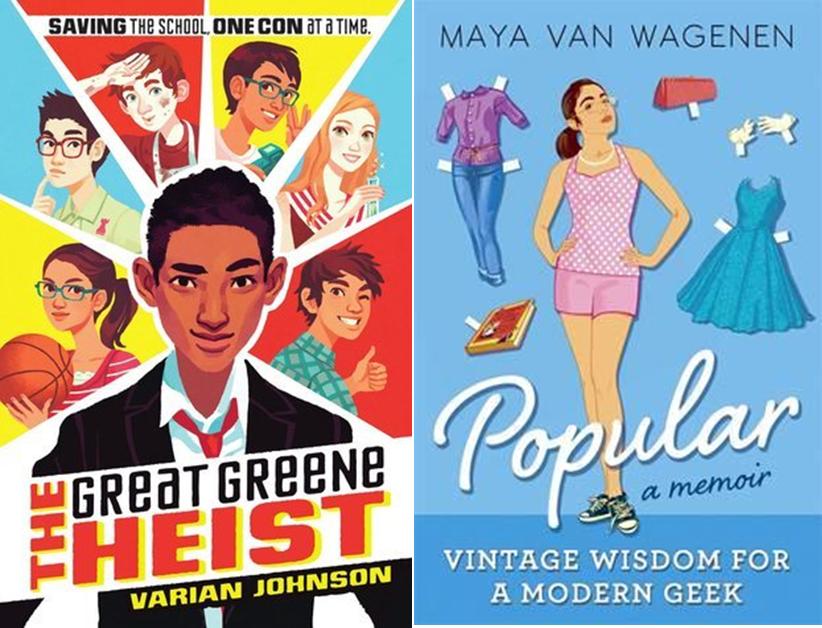
I’ll admit it.  I struck gold last weekend.  Have you been following the #weneeddiversebooks hashtag on Twitter?  It blew up probably three weeks ago now, and it’s been pretty great.  I found an amazing resource for people wanting to write diverse characters that are outside their experience, here:  http://diversitycrosscheck.tumblr.com/, which was only one among many things I learned.  I also learned about The Great Greene Heist, and Popular.  Basically, these books were a fest of stuff outside my experience, and I loved them.  After all, experiencing new things is the best reason to read ever.

The Great Greene Heist, by Varian Johnson:

There’s a movement behind this book founded on a single principle: in America capitalism rules – we all have to put our money where our mouths are in order to ensure that diverse books keep being published.  If we could get one on the Bestseller list, that would be even better.  That’s how I came across The Great Greene Heist, by Varian Johnson.  In a bid to show people that diverse books can make money, publishers, booksellers, and authors are banding together behind this book to make it a best seller.  Kate Messner’s website has more on this, here: http://www.katemessner.com/more-than-words-a-challenge-for-everyone-whos-been-asking-for-more-diversity-in-kids-books/.  It’s a story with a Black protagonist, a Hispanic love interest, and a very diverse cast of characters pulling a heist for the good of the school.  Most importantly it features the protagonist, Jackson Greene, prominently on the cover.  It does a great job of including all the things people say they want when they want diverse books.

If I read middle grade, I usually read fantasy.  I will admit that I wouldn’t have purchased the book without urging.  Still, I figured that it was worth the ten bucks just to support a movement that only good can come from.  I was rewarded tenfold.  Ten bucks was more than worth it for the entertainment I gained.  I loved, loved, loved the book.  Can I say loved one more time?

The basic plot is this: Keith is trying to buy his way into becoming class president, and along the way he has plans to slash the budgets of every club that isn’t his beloved Gamer Club.  Gaby, the gal who should be president, isn’t sure what to do.  Especially because she has an honest and smart platform that Keith keeps stealing.  It’s all up to Jackson to stand up to middle school authority and  run a heist guaranteeing Gaby a win – despite her protestations that he shouldn’t and his certain expulsion if he fails.

From the Blitz at the Fitz to the Mid-Day PDA, to all of Jackson’s gutsy ideas, I was hooked so fast.  If the Thomas Crown Affair and Ocean’s 11 happened in a junior high, this book would be it.  There is even a set of con rules.  If I could have been half as confident or as fun as these kids are at that age, I bet Junior High wouldn’t have been as terrible.  Johnson’s characterizations were spot on as well, avoiding cliche and treating racial issues with maturity and respect.  This is a book about people in a school that feels so real, with just a smidgen of utopia thrown in to make it irresistible.

The bonus part of this equation is Varian Johnson.  I didn’t know about his writing before picking up this book.  Most of his older stuff is the kind of thing I read: books for adults.  I can’t even tell you how happy that makes me, because probably 75% of the new stuff I read is just not worth talking about.  This is good new stuff, guys!

So the long and short of it is that I would have told you to go buy the book anyway to support diversity, but the quality of the work makes me say it WAY more emphatically: this one is worth your time.

Popular, by Maya Van Wagenen:

At the urging of her mother, Maya Van Wagenen decides to follow the advice of a self-help book her father unearthed from the attic.  The book was written in the 1950s by a woman named Betty and she’ll follow it all to the letter, keeping a diary in between.  While the concept is a cute one, it’s really Maya’s situation that makes the book unusual.  She’s living in a town on the Texas/Mexico border where there are constant drug dogs and alarms where they have to shelter in the multipurpose room and keep silent because of police activity. That’s a lot of pressure for middle school.  Maya is chipper throughout it all.

This book is just great.  I was attracted by the paper dolls on the cover (I’m a sucker for paper dolls), but I cracked the spine and couldn’t put it down because of Maya’s strong (and often funny) voice.  The book started with the sweetest forward by Betty about Maya which swept me off my feet.  Despite the huge differences in circumstance, Betty’s words ring true and are still helpful to Maya.  That’s what was most mind-blowing to me.

The pictures in the book were my favorite parts, as were the times when Maya had to follow anything that clearly wasn’t applicable advice anymore.  Like her cotton gloves, huge straw hat with a bow, and pearls that she has to wear to church all the time.  Or the gigantic girdle.  The diagram she draws of how the girdle rides up and gives her four butts is especially amazing.

So, in short, this book is another one I highly recommend.  I burned through it in only a day because I couldn’t put it down.  It’s rare these days that I read two books in a single weekend but I just did.  I wish I had this kind of luck with all the new books I pick up!

Categories: Book Reviews | Tags: , , , , , , | Leave a comment

Book Review – Diana Wynne Jones

I get on kicks where I read a whole bunch of one author at a time, and it appears that this is one of those times.  Diana Wynne Jones is someone I wished I had discovered earlier, because I would have worshiped her books had I read them as a girl.  As it is, I find myself loving them and wishing I was clever enough to have written something half so amazing.  Howl’s Moving Castle and Chrestomanci are what she is known for, but she has tens of obscure books that are also wonderful.  Here are my thoughts on two of them:

DWJ

The Dark Lord of Derkholm:

The Dark Lord of Dirkholm wasn’t what I thought it would be. I expected magical, funny, and chaotic. After all, it’s a Diana Wynne Jones novel, and those are the things she does best. This was funnier than that, and more awful than that as well.

The basic premise is that a bumbling family man, farmer, and wizard named Dirk is elected to play Dark Lord to a host of pilgrim parties that come through their world via portals every Fall. The pilgrim parties are destroying their landscape, and an oracle says that if they elect Dirk as Dark Lord, the pilgrim parties will end. Dirk is famous for his genetic experimentation on animals, breeding intelligent and, frankly, really cool things. There are the Friendly Cows, the Carnivorous Sheep, the Flying Pigs, the Sentient Dogs. And then there are his “children:” Griffins bred from he and his wife’s DNA, and reared with his natural-born children. They all work together to make the pilgrim parties go well (for a while).

It’s a funny commentary on the Dungeons and Dragons genre, and Jones really knows her stuff. It’s hilarious to see regular human beings conform to the tropes of the genre for heaps of overzealous tourists. Among the hilarity, though, Jones makes a more serious point: the fact that this isn’t actually a game. Killing isn’t a game, and neither is war, or sacking villages, or being kidnapped, or being forced to fight in an arena. It’s mostly well done, although it left me reeling a few times as she transitioned between funny and not. Sometimes it was seamless, sometimes it wasn’t. I definitely lost the sense of profluence during some of the many battle scenes with the Dark Lord’s army.

I’m a HUGE fan of Jones’s work and I’ve read tons of it. I liked this book more for the world and the characters than for the story itself. Still, I enjoyed reading it and would recommend it to other fans. If you haven’t read a lot of Diana Wynne Jones, things like Aunt Maria, Howl’s Moving Castle, Fire and Hemlock, Dogsbody, and the Chrestomanci series were much better.

Homeward Bounders:

Speaking of books by Diana Wynne Jones: The Homeward Bounders is another that is waiting for a full review. This one is about a boy who finds that his world is actually a game board in use by a bunch of demons. He’s cast out of his world for the discovery, forced to wander the boundaries (the bounds) of hundreds of worlds until he can get home again. Along the way, he picks up a motley collection of other Homeward Bounders who are intent on destroying the demons and reclaiming their worlds together.

This book was more of the Diana Wynne Jones type. A whole collection of random occurrences pull together at the end to all make brilliant sense. Along the way, her collection of worlds is fascinating and funny. While the myths in her stories are nebulous and are hard to pinpoint, these felt like Greek. There is an ultimate Homeward Bounder who is so similar to Prometheus, but the Flying Dutchman and his crew also make an appearance, among others.

The worlds are in flux, so the story seemed less anchored than some of her other stories. The rules are always changing. While I think this was probably not purposeful, it serves the story well enough. Because of the multitude of worlds, this book also has a strange factor that is deeper than her other books. For the queen of strange, that’s really saying something… I would certainly recommend the read, though. Not her absolute best, but “not her best” by Diana Wynne Jones is often high and far above the best of others.

Categories: Book Reviews, Fiction | Tags: , , , , | Leave a comment

Book Review: I Thought It Was Just Me (but it isn’t) by Brene Brown

41hUBLww6tL

I had heard Brown’s TED talk several times, and her follow up TED talk as well.  She’s a strange bundle of confidence, scientific method, insecurity, and hilarity.  At the end of it all you just have to love and trust her.  And she has powerful things to say in her scant few minutes of time in front of the camera.  I’ve been thinking for a while that I should pick up a book of hers because she had such moving things to say, but I’m a horrible procrastinator and I kinda hate driving.  All things that conspire to keep me out of the book shop.

Brian and I were picking an audio book at Barnes and Noble for our road trip when I saw the book (who have the worst selection of audio books I have ever seen, by the way.  We ended up with Audible instead).  I scoffed at the title.  I have an abhorrence of self-help book; mostly because they rarely help me, but also because of the cheese factor.  But when I saw her name at the end of it, I decided it would probably be better than the regular sort.

I read it in fits and starts in our breezy hotel room in Monterey.  It was a revelation.  I learned that I have pretty good Shame Resiliency (thanks Kathy and John!), but that I still have shame about some very weird things.   Like writing.  Like religion, and vaccinations and health care.  Like being a woman.  So many of the superficial fights Brian and I repeat seemed contained in that slim book, and I was the problem.  Knowing that has allowed me to discuss things like an adult.  Her stories of other women trying to just get through it all helped me know I wasn’t alone, either.

In short, I have a feeling this book will be life changing for me.  I think everyone I’ve ever met should read it, male or female.  Seriously.  Go get it and read it NOW.  While you’re waiting for it to arrive, take a look at her TED talk: https://www.ted.com/talks/brene_brown_on_vulnerability

Categories: Book Reviews | Tags: , , , | 1 Comment

2 Book Reviews: Shannon Hale’s Latest

Shannon Hale

Dangerous

Okay, I’m going to just warn you right now.  This is a bit spoilery.  I kept enough of the twists, turns, and secrets quiet that you’ll still enjoy the book a bunch if you haven’t read it, but there are a few things in there that maybe you wouldn’t want to know ahead of time, and I thought you might want to be forewarned.

I originally ordered the book through The King’s English bookstore.  I’m a gigantic Shannon Hale fan and she promised to sign everything coming from the King’s English on her website a few weeks ago.  She’s was on a huge tour, though, (possibly without much time to go sign a billion books at the local bookstore), and I’m a few states away.  The picture of the book cover was so shinny and purple.  It taunted me.  Other people were reading it, I just knew it.  I was glad I had a nice signed hardback in the mail, but I was going crazy.  So I bought it twice – Kindle instant gratification for the win.  I spent the rest of that Sunday buried in it.

There was so much that I liked about Dangerous.  There are scads of amazing things to laugh at, from Dad’s terrible puns, to the fact that the main character’s name is Maisy Danger Brown, to the nicknames she gives her false arm.  It’s a kick-ass story, (the sort of thing I love) with a superhero twist.  I can already tell that it’s going to be one of those things that I re-read over and over again.  It was well worth every penny of buying it twice.

Now to the critique part: While I loved everything about the book once the story really got rolling, it did take a bit for me to buy it all.  Hale says on her website that it’s meant to be a modern-day superhero story, but it felt more to me like the very near future.  I had a hard time suspending my disbelief at first and falling into the world.  Even now I find some of it  hard to swallow.  Does a woman really take five children into space for winning a camp relay without any parental waivers or permissions, or any advance notice to the kids?  Maisy’s parents accept her mutated powers story, agree to move to Florida, and destroy their middle class life almost without pausing for reflection.  It also was strange to me that Maisy’s mom suddenly had a back story where she was part of a band of Mexican freedom fighters.  Cool, yes, but totally out of left field.  I found some of it more believable after hearing characters explain later, but it still gave me pause as I was reading through it all the first time.  Some of my disbelief could also be my own unfamiliarity with the comic book genre, I’m willing to admit that.  If a comic book were suddenly a novel, this book is it.

It was Maisy herself that pulled me through the whole thing and eventually left me devouring her story like I was starving.  She is one spitfire of a girl, full of flaws but with a kind heart.  I thought Hale’s choice not to have Maisy kill any of her team mates (despite their desire to kill her) was admirable and telling about the kind of superhero Maisy will become.  She goes from being the sort of girl you wish was your best friend, to being the girl you cheer for, to being the kind of girl you want protecting your universe.

I should have known Hale’s feminist tendencies enough to realize that the climax of the story would hardly rest on the back of Maisy’s complicated relationship with Wilder.  Still, it blindsided me in the best possible way to realize that he was not a real problem at all in the scheme of things.  The climax was so much bigger and impossible than I had considered.  It was very well done; thrilling and scary at the same time.

In short, I’m obsessed despite the flaws.  I hope there are sequels.  I’m considering giving one of my children the middle name “Danger.”  I’m already waiting for the movie to come out.  I’m sporting the Dangerous temporary tattoo that came with my signed book – tech powers for the win! I’m attempting to convince everyone I know to read it. So get on that, okay?

Ever After High, Book 2 – The Unfairest of Them All

I frankly expected to hate book 1.  I mean, it was commissioned by Mattel to sell a line of children’s dolls.  That was really its sole purpose.  But Shannon Hale signed on to write them.  I couldn’t wrap my head around the dichotomy – would they be good, or would they be bad?  Was it worth spending $12 to find out?  I love everything Shannon’s done, so I ultimately decided to take the chance and spend the money.  I actually enjoyed it.  A lot.

Book 2 came out late last month, and was exactly what it promised to be, with a little social justice thrown in for good measure: When their friend Mattie Hatter is accused of setting the Jabberwocky loose, Raven Queen and Apple White band together to save her from banishment.  It features a bevy of terrible fairy tale puns and a hilarious cast of characters.  The peas porridge banter was especially hilarious: “Some like it cold, you know,” says the Evil Queen, ominously.   While the silly was much appreciated, there was also a little meat there.  The main conundrum of the novel is whether to choose to be a bad person to ensure someone else’s Happily Ever After, or whether it’s okay to choose to be yourself even if it means no one gets a Happily Ever After.  Nicely done.

I wasn’t expecting much more than a silly time from this novel, and it delivered in spades.  I read the kindle version – complete with pink and purple chapter headings.  I was drooling over the actual novels in Barnes and Noble the other day, though.  They’re this pink-and-purple-gasm of frilly inked borders and embossing which made the girl in me want one immediately.  The only thing I was left not loving was that Shannon wrote this book with her husband, Dean, but his name isn’t on the cover.  I wish he got a little more credit than Shannon’s thank you in the back, because I’m sure he deserves it.

Categories: Book Reviews, Fiction | Tags: , , , , , , | Leave a comment

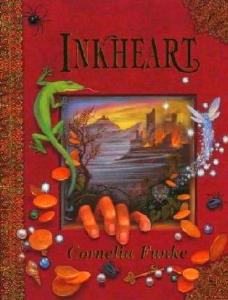
Book Review: Inkheart

Inkheart_book

Inkheart, by Cornelia Funke

I picked this one up because my father said, “Have you read Inkheart yet?  You would really love it.” And then my aunt said, “you haven’t read Inkheart?  You really HAVE to.” On Christmas, she wrapped up my cousin’s old battered copy and put it under the tree for me.  Anyone over the age of 21 doesn’t get gifts from extended family, that is the rule, but a re-gift is allowed and welcomed.  I was so excited to start it.

It is exactly the sort of book I should like, and I know I would have devoured it with relish had I found it twenty years earlier.  I read it today with a mild sort of amusement that never took hold to become obsession.  I know this is not because it’s a children’s book that it didn’t quite pull me in, although I was always on the brink of it.  There were a number of problems I had with it that I just couldn’t seem to get over. 

The biggest problem for me was the character of the writer.  The good guys find the writer of the book and convince him to write a new, happy ending.  That is how they solve the main crisis.  It’s a little more complicated than that, but not much.  The writer isn’t even hard for them to find.   It seemed like such a cop-out.

I was also not very convinced (for a long time), that the bad guys were all that bad.  They were mostly token bad guys – shooting cats in the alley, imprisoning children, and generally thieving, bullying, and being thugs.  I was never really afraid that the good guys wouldn’t win.  There was a fascination with fire that ran through the whole novel that I also felt was never fully realized. 

The original novel is in German.  I read a translation, and I’ve decided that I’m pinning all the problems on the translator (even the plot points that are really the fault of the writer).  Aside from the things above, the book really is a wonderful romp.  My favorite parts were the bits from other novels that were sprinkled throughout.  They were so fun to recognize, like coming across old friends.  Tinker Bell comes to life in it, and Long John Silver (thankfully) does not.  It also features a spunky elderly aunt who is hilarious.  You have to love Eleanor. 

In short, I would recommend the read and I’m glad I read it myself.  I know there are sequels, and I’m left with a comfortable feeling that I don’t need to purchase the next one, but that I might enjoy it if I decided to some day.  If you have an eleven year old reader at home, they will probably be obsessed. 

Categories: Book Review | Tags: , , | Leave a comment

Men, Women, & Manners in Colonial Times, Volume I

Sydney George Fisher’s Men, Women, & Manners in Colonial Times, written in 1898, depicts the general history and customs of Colonial America through a heavily biased lens.  The book is divided up regionally, clearly showing all of the many reasons people immigrated to the Americas, and how that affected their dispositions and customs by region.  While this book is very entertaining, the history that was correct is relayed through a partial viewpoint, and some of its assertions are hard to take seriously.  This book is very worth the read, but more for the insight on how people in the nineteenth century viewed our colonial history than for the actual history relayed in the book itself.

Although much of the history relayed in the book is technically correct, Fisher’s biased portrayal of historical figures and regions is comical.  Modern historical accounts tend to be fairer to these people, presenting facts and letting readers form their own opinions.  Fisher, on the other hand, forms his opinion for the reader.  For example, Fisher calls John Smith “a lying braggart, an adventurer, a Gascon, and a beggar” (Fisher 24), claims that the puritans “pried into people’s history and business in a way that was very offensive to strangers and travelers – a habit which has since been known as Yankee inquisitiveness” (Fisher 205), and brands Rhode Island the “Isle of Errors” (Fisher 303).  Prejudicial language appears on nearly every page.  These descriptions of the peoples of Colonial America, although amusing, do not paint an unbiased picture of what it was really like to live in these times.  The narrative is more indicative of the attitudes and ideas of the time the book was written than of the times it is talking about.

Many of the customs set out in the book are hard to accept as true. Most notable of these customs is the purported South Carolinian custom of gouging out other people’s eyes for fun.  Fisher assures us that it was a common practice, essentially similar to young children roughhousing and yelling “uncle” when they have had enough.  Supposedly, these gentlemen would press on their friend’s eye until the friend said the code word of “King’s Cruse”, but it was a mark of terrible weakness to use the code word, no one would say it, and many lost an eye this way.   It seems completely ludicrous that this practice would be widespread enough to warrant inclusion in a book on colonial customs, and there seems to be no supporting evidence that this practice was as widespread as Fisher claims.

Men, Women, & Manners in Colonial Times is an entertaining read.  Although there are several problems with the book as a historical account of Colonial Times, the book is an entertaining picture of the 1898 view of our history.  The wildly off the mark depiction of our history in Men, Women, & Manners in Colonial Times makes one wonder how modern books on history will be received a hundred years from today.  If they are as entertaining as this book, at least they will have stood the test of time.

Categories: Book Review | Tags: , , , | Leave a comment

Create a free website or blog at WordPress.com.